FinOpsly Launches AI Cost Governance, Establishing a New Financial Operating Discipline for Enterprise AI
“FinOps for AI” gives enterprises one economic model to plan, govern, optimize and prove the value of AI spending across models, software, cloud and data
CINCINNATI, OH, August 12, 2026. Artificial intelligence is changing more than how enterprises operate. It is changing the economics of technology itself.
Every employee prompt, autonomous agent, model inference and AI-powered customer interaction can generate costs across software subscriptions, foundation models, GPUs, cloud infrastructure and data platforms. As AI becomes embedded across the enterprise, technology spending is becoming increasingly variable, decentralized and difficult to connect to business outcomes.
The problem is no longer simply seeing the cost.
It is governing the economics behind it.
Today FinOpsly introduced AI Cost Governance, a financial operating discipline that gives enterprises a unified way to understand, manage and prove the business value of AI. Positioned as “FinOps for AI,” it extends the principles of cloud FinOps beyond infrastructure to the entire economic footprint of artificial intelligence.
“Enterprises don’t have a visibility problem. They have a control problem,” said Kiran Jain, CEO of FinOpsly. “Teams can see costs, but they struggle to connect those costs across vendors, establish accountability and tie spending to business value. AI Cost Governance closes that gap.”
One Economic Model for Enterprise AI
The challenge is accelerating from two directions.
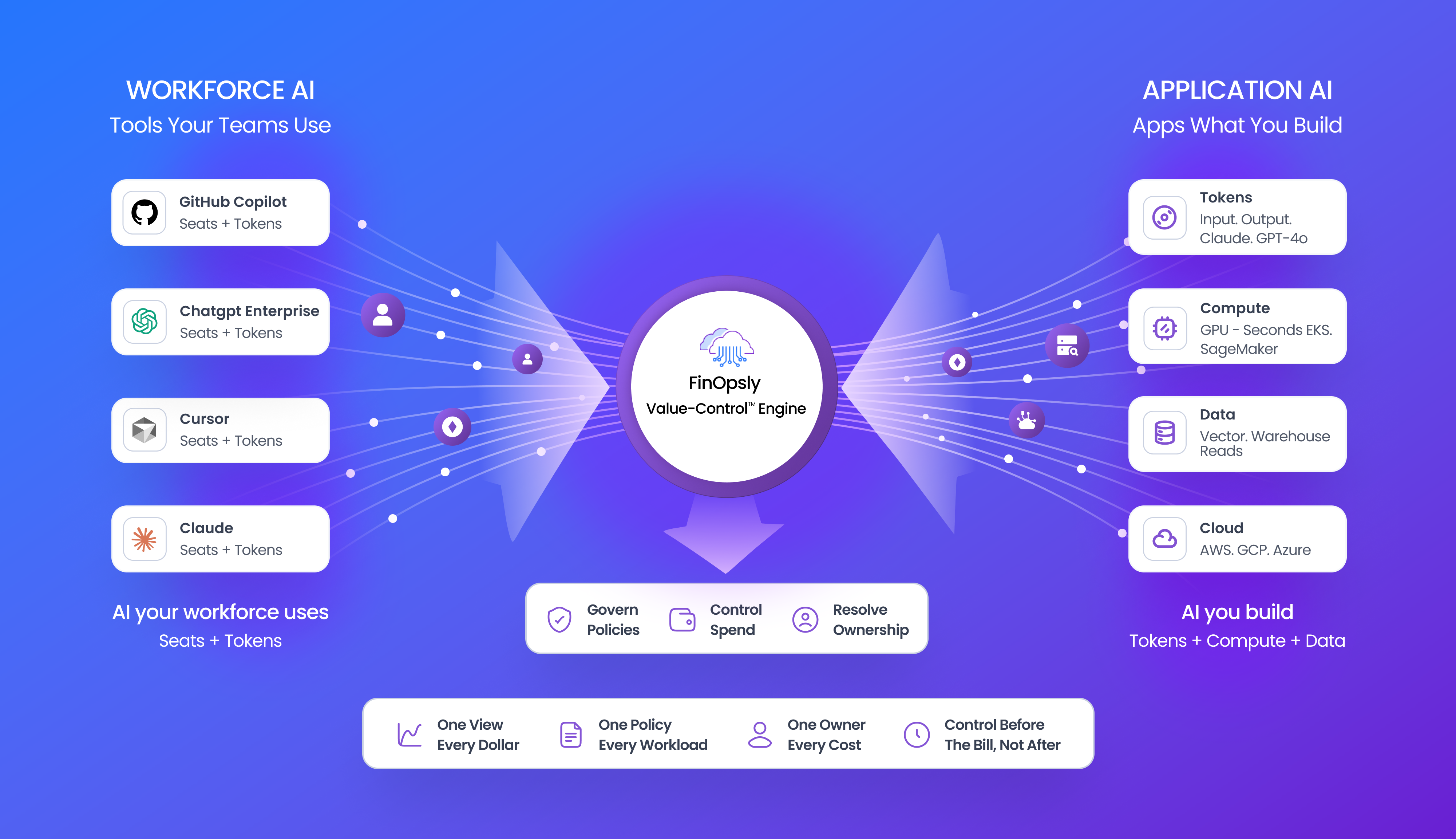
Enterprises are rapidly adopting workforce AI tools such as ChatGPT Enterprise, GitHub Copilot, Cursor and Claude. These increasingly combine recurring software fees with variable usage charges, turning what was a predictable per-seat expense into a dynamic cost spread across employees, teams and business units.
At the same time, they are embedding AI into customer experiences, products and internal applications. A single AI interaction can create costs across multiple models, software platforms, cloud services, GPU infrastructure and data systems.
Each provider offers its own usage data, budgets and controls, but those systems operate independently.
Managing five AI vendor consoles is not governance.
It is fragmentation.
FinOpsly creates a shared economic model across the AI stack, extending its Value-Control™ operating model across four connected pillars: AI, software, cloud and data. Value-Control pairs two disciplines most organizations run separately: governing spend through policy before it is committed, and proving what that spend returned.
Organizations can use FinOpsly to:
Plan before spending
Costix™ models AI workloads before deployment, so teams compare architectures, models, compute and data requirements before committing resources.
Connect cost to the business
Attribute spending to employees, teams, applications, customers and business units, then explain what changed and why through Ask FI™ in Microsoft Teams and GitHub Copilot, rather than another console.
Act on opportunities
FinOpsly identifies cost spikes, runaway agents, unused software, overlapping tools and workloads approaching budget limits, then routes each to an accountable owner.
Prove the value
Teams measure forecast accuracy, attributable spending, realized savings, cost-to-serve and margin against continuously updated baselines.
The result is a shift from managing individual AI invoices to managing AI as an enterprise economic system.
Early deployments demonstrate the impact.
A national healthcare organization realized 23% savings within 90 days, increased attributable spend from 68% to 99%, narrowed budget variance from ±25% to ±2%, and reached 93% adoption of optimization recommendations.
A large financial services enterprise identified more than $1 million in cost-reduction opportunities within 60 days while attributing 95% of spending to projects, applications, business units and teams.
“The real value of FinOpsly is connecting AI, cloud and data visibility to action,” said JT Smith, Director of Cloud & IT Infrastructure at a leading Healthcare organization. “We can understand where costs are coming from, prioritize the highest-impact opportunities, and track whether savings or profitability are actually realized.”
“AI cost does not stop at token usage,” said Lathika Hegde, Chief Product and Technology Officer at FinOpsly. “As AI becomes embedded in virtually every enterprise application and workflow, financial complexity will multiply. The organizations that scale AI successfully will be the ones that can connect technical usage to ownership, policy, margin and measurable business value.”
AI is approaching the financial inflection point cloud computing reached more than a decade ago. The first phase was defined by experimentation, adoption and speed.
The next will be defined by accountability, economics and value.
Cloud FinOps taught enterprises how to manage variable infrastructure.
AI Cost Governance will teach them how to manage variable intelligence.
FinOpsly is building the financial discipline for managing it.
For more information, visit www.finopsly.com/ai.
About FinOpsly
FinOpsly is the AI Cost Governance platform helping enterprises understand, govern and optimize the true economics of artificial intelligence. By connecting AI usage with the software, cloud and data systems behind it, FinOpsly enables organizations to plan spending, establish accountability, optimize costs and prove measurable business value across enterprise AI.